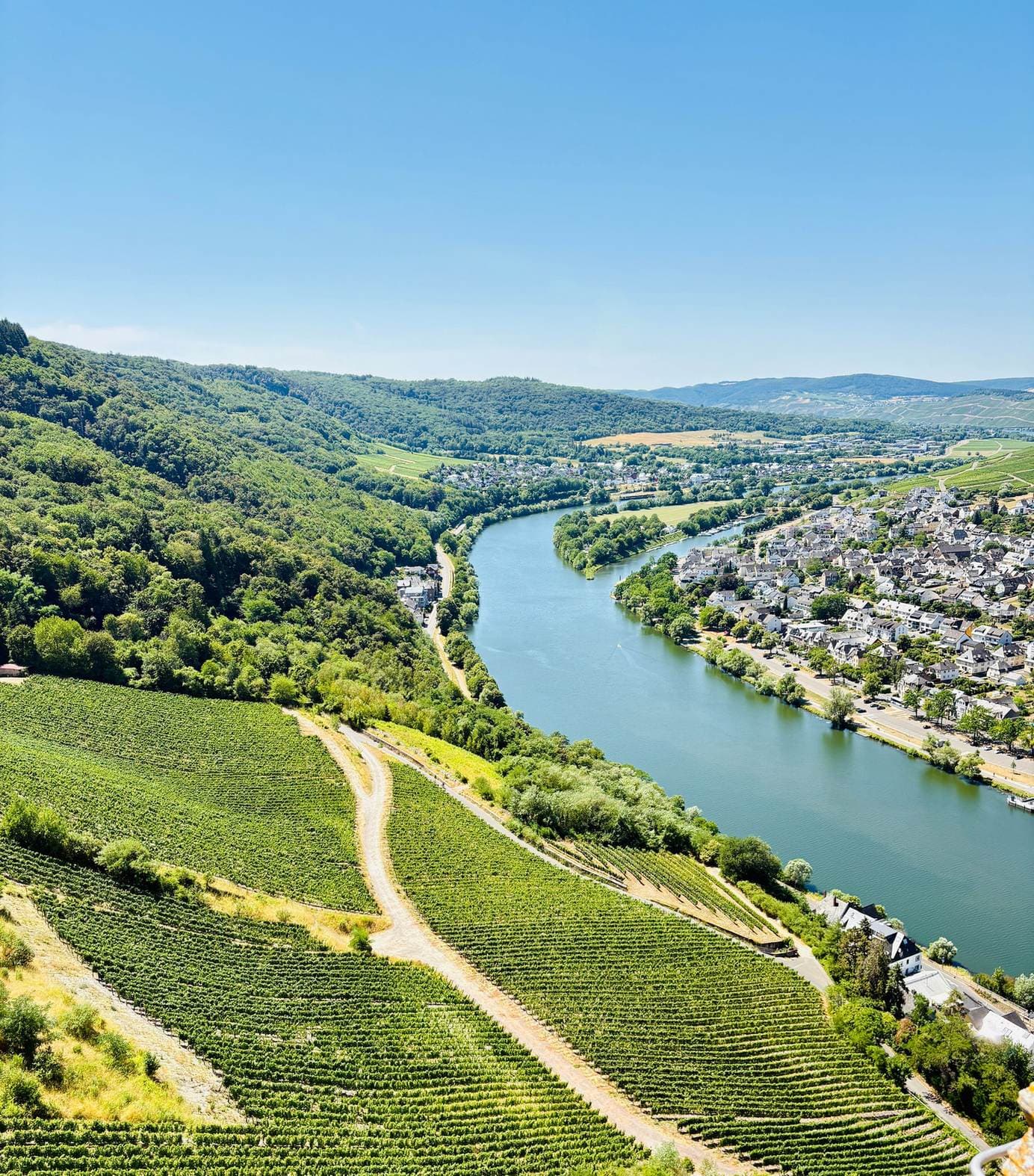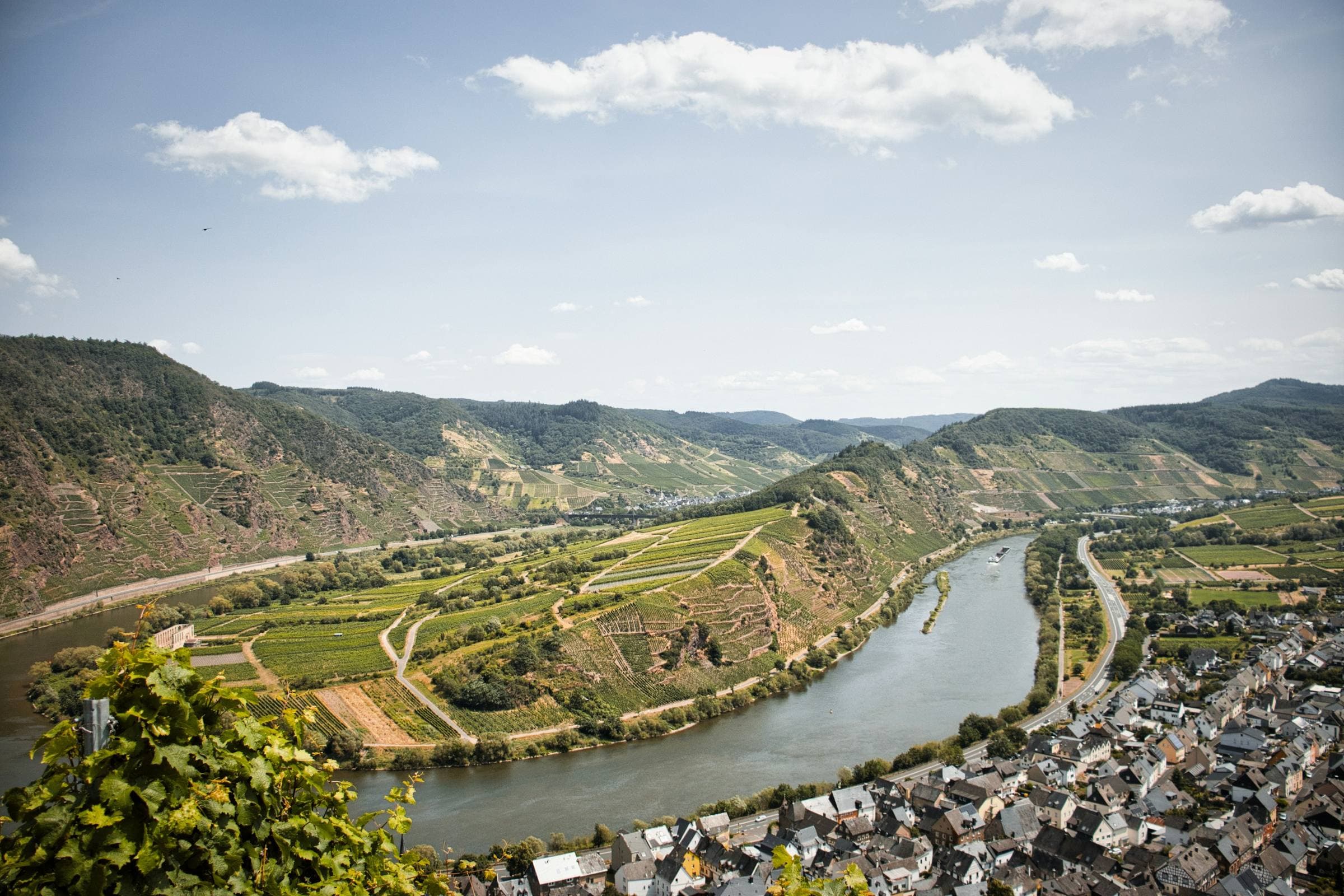
Stand in Bremm on the Mosel, tip your head back, and you understand at once why this slope is famous. The Calmont rises so abruptly behind the village that its rows of vines look more like climbing routes than farmland. Everywhere – in brochures, on wine labels and in press releases – it bears the same title: Europe’s steepest vineyard. A fine superlative. The only question is what exactly it measures.
A matter of numbers
Let us start with what can be looked up. In one press release, Rheinland-Pfalz Tourismus gives „65 Prozent Hangneigung“ (our translation: “a 65 per cent gradient”); another release from the same press office speaks of „rund 60 Grad“ (our translation: “around 60 degrees”). The Deutsches Weininstitut (German Wine Institute) writes of a slope of „bis zu 60 Grad“ (our translation: “up to 60 degrees”), and the municipality of Bremm says much the same on its website. Wikipedia gives „bis zu 68°“ (our translation: “up to 68°”) and converts this to around 248 per cent. The Amlinger estate in neighbouring Neef speaks of an average of 56 and a maximum of 65 degrees. And in a feature on the Calmont Region website, the monorack climbs a slope „mit mehr als 70 Prozent Steigung“ (our translation: “with a gradient of more than 70 per cent”).
That may sound like nuance, but it is not – particularly when a single source uses both units. Per cent and degrees are two different measures. A gradient of 100 per cent equals 45 degrees – one metre of rise over one metre of distance. So 65 per cent is roughly 33 degrees: very steep, but walkable. Sixty-five degrees, on the other hand, would be around 214 per cent – terrain on which you could barely stand without using your hands. Somewhere in this confusion a transcription error has probably crept in and been diligently copied ever since. For a cultivated vineyard, 65 per cent sounds more plausible than 65 degrees, although individual rocky sections can of course be far steeper. We have not found an official survey that settles the matter cleanly.
Does the Calmont have rivals?
It does not claim the title alone. In Baden, in the Bühlertal, lies the Engelsfelsen site, for which the wein.plus wine lexicon gives gradients of up to 75° (373%) in some parcels. Wikipedia lists both sites side by side as Europe’s steepest. Anyone who tries to measure it soon arrives at the question of whether we mean the steepest vine, the steepest parcel or the steepest contiguous site. What speaks for the Calmont is above all its sheer scale: a large, contiguous, terraced slope which, according to the German Wine Institute, rises around 290 metres above the Mosel. As far as our research goes, there is no independent comparative measurement of all the contenders. The superlative is therefore more a well-tended tradition than a measured result.
Working on the wall
What the steepness means for the winegrowers is beyond dispute. Rather less clear is how large the Calmont actually is. Wikipedia puts the Bremmer Calmont single site at around 33 hectares. The German Wine Institute speaks of 22 hectares in total, of which only about 14 are cultivated today, and the municipality of Bremm writes that by the end of the 1990s only 11.5 of a former 22 hectares of planted vineyard were still being worked. The 22 hectares, then, refer to the area once under vine. What the 33 hectares refer to – perhaps the entire registered site, rocks and fallow land included – the source does not say, and we have not found an official figure.
To halt the abandonment, a simplified land consolidation procedure was initiated, according to the municipality of Bremm. The Calmont Region describes years of persuading landowners: in the end, 42 owners sold their tiny plots, leaving 70 contiguous parcels.
Machines help only so much. Since the 1990s, monorack railways – single-rail rack systems originally from Japan – have run through the slope. The rest is handwork: the DWI and the municipality of Bremm both cite up to 1,800 working hours per hectare per year, and according to the DWI the grapes have to be carried down the slope to the harvest trailer on people’s backs. One of those who saved the Calmont from scrub by replanting it was the Bremm winegrower Ulrich Franzen. He died in June 2010 in a work accident when his narrow-gauge tractor overturned – though not in the Calmont itself: according to Vinum, it happened while spraying on a flat site on the other side of the Mosel, and riesling.de places it near Stuben convent. His son Kilian Franzen has run the estate ever since together with his wife Angelina, on almost ten hectares, mostly in the Calmont and the Neefer Frauenberg.
The bedrock dates from the Devonian: the DWI speaks of quartzitic sandstone and weathered slate, the municipality of Bremm of slate and greywacke. Riesling dominates. According to the Amlinger estate, the old dry-stone walls on which the terraces rest have been built without mortar since the early Middle Ages.
Climbing among the vines
Those who want to experience the slope for themselves take the Calmont via ferrata (Klettersteig). The municipalities of Bremm, Ediger-Eller and Neef created it in 2002, and the German Alpine Club secured it. Over roughly 3.5 kilometres it crosses the vineyards with steel cables, ladders and iron footholds; you should allow around three hours. There are shelters along the way, for instance at the Galgenlay and at the summit cross, which is reached via a side path, and in summer, according to the Calmont Region, the rock heats up to „weit über fünfzig Grad“ (our translation: “well over fifty degrees”). A head for heights, sturdy footwear and plenty of water are not a recommendation but a prerequisite.
At the top a surprise from antiquity awaits. A Gallo-Roman ambulatory temple once stood on the summit. The municipality of Bremm refers to archaeological excavations in 2005, while the cultural landscape register KuLaDig mentions more than 120 coins from the early 2nd to the late 4th century, unearthed during earlier illicit digs. The temple has been rebuilt on its original foundations.
Old, steep, sought after
How old viticulture on the Calmont is cannot be pinned down to the year. The German Wine Institute points to the travel poem by Venantius Fortunatus from 588, while the municipality of Bremm gives 1373 as the first documentary mention. The two need not contradict each other: one is a poem about a journey on the Mosel, the other a charter.
In the end, the exact number of degrees may not matter all that much. Anyone who has hung from a steel cable on the Calmont and looked down at the Mosel loop will not want to question the title again. And anyone who opens a bottle from this site is drinking something other than a number anyway: up to 1,800 hours of handwork per hectare.