Where it comes from
The oldest known mention dates from 1435: a cellar account of the Counts of Katzenelnbogen in Rüsselsheim am Main records vine cuttings of “rießlingen”. Genetically, Riesling is a child of the Rhine valley. One parent is Weißer Heunisch, an old, high-yielding variety. According to current knowledge, the other goes back to a cross between a wild vine and Traminer.
The rise to a quality variety began in the 18th century. Monasteries and prince-bishoprics along the Rhine and the Mosel deliberately planted Riesling. In the late 19th century the best German Rieslings fetched prices on wine lists on a par with the great Bordeaux. Today Germany has the largest area under Riesling in the world: the grape accounts for just under a quarter of all its vineyards.
What defines it
Riesling buds late and ripens late. That sounds like a drawback, but it is the secret of the grape: the bunches hang on the vine for a long time, building up aromas while keeping their acidity. This acidity is the backbone of every good Riesling. It makes dry wines taste fresh and juicy, balances residual sugar and allows the wines to last for decades.
Add to that a range of aromas that stretches from green apple, citrus and lime through peach and apricot to herbs, white blossom and a smoky, salty spice. Riesling is almost never aged in new oak. Winegrowers want to show the fruit and the origin, not the cellar.
Soils & regions
Riesling is considered the grape that lets you taste its soil most clearly. This is not romanticism: anyone who tastes Rieslings from slate and from limestone side by side will notice the difference immediately.
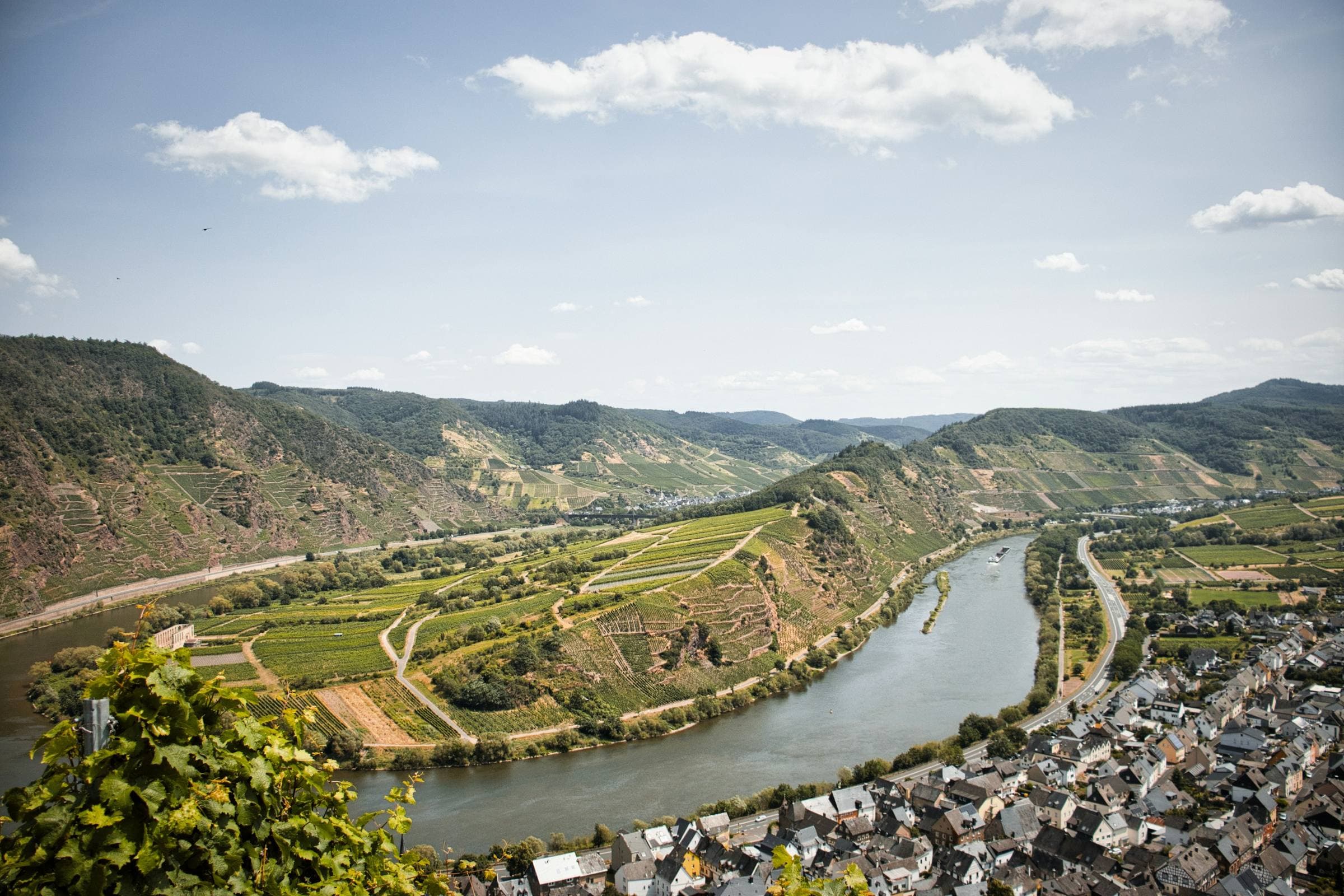
- Mosel, Saar, Ruwer: steep slopes of Devonian slate. Filigree, often light wines with smoky spice and plenty of tension. The home of classic Kabinett (the lightest Prädikat level, traditionally light and delicate, often with some residual sweetness).
- Rheingau: Taunus quartzite, slate, loess. Elegant, straightforward Rieslings with a long tradition, from Kloster Eberbach to Schloss Johannisberg.
- Nahe: a mosaic of volcanic rock, slate and sandstone. Great diversity in a small area.
- Rheinhessen: limestone and marl around Westhofen and Nierstein (Roter Hang). Powerful, dense dry wines.
- Pfalz: red sandstone, limestone, basalt and a warm climate. Ripe, juicy dry Rieslings.
- Mittelrhein & Franken: slate on the Rhine, shell limestone on the Main. Small volumes, often underrated.
- Austria: Wachau, Kamptal and Kremstal on gneiss and primary rock. Dry Rieslings with power and spice.
- Alsace and the New World: Alsace stands for dry, often weighty Riesling. Clare and Eden Valley in Australia, New Zealand and the Finger Lakes in New York show how far the grape can travel.
From dry to nobly sweet
Hardly any other grape covers the whole scale – and at the very highest level. Broadly, four styles can be distinguished:
- Dry: no more than 9 g/l of residual sugar, provided the acidity is high enough. From a light Gutswein (estate wine) to a Großes Gewächs (GG – the dry wine from a Grand Cru site, as defined by the VDP, Germany's association of top estates).
- Feinherb / halbtrocken (off-dry / medium-dry): a noticeable but restrained sweetness. Halbtrocken is legally defined (up to 18 g/l), feinherb is not, but it usually means something similar.
- Fruity-sweet: the classic Mosel style. Kabinett and Spätlese (“late harvest”, the next Prädikat level up) with distinct sweetness, low alcohol (often 7.5–9% abv) and plenty of acidity. Light, dancing and astonishingly good with food.
- Nobly sweet: Auslese, Beerenauslese, Trockenbeerenauslese and Eiswein. Concentrated, often marked by noble rot, and with practically unlimited ageing potential.
Reading the label
German labels are considered complicated, yet they follow two logics. The first is the Prädikate – Kabinett, Spätlese, Auslese and so on. They describe the must weight at harvest, in other words the ripeness of the grapes. Traditionally they stand for fruity-sweet wines, but they can also be made dry.
The second is the origin pyramid of the VDP (Verband Deutscher Prädikatsweingüter). It is structured as in Burgundy: Gutswein (estate wine), Ortswein (village wine), Erste Lage (roughly Premier Cru) and Große Lage (roughly Grand Cru). A top dry wine from a Große Lage is called a Großes Gewächs (GG). Since 2021 German wine law has also been adopting this principle step by step: the narrower the origin, the higher the standard.
For our best-of lists this means: a Gutswein can be a fantastic everyday wine, and an Ortswein from a top estate is often the best value in the entire range. Some examples →
Ageing & the petrol puzzle
Young Riesling shows above all fruit and freshness. Over the years it becomes more complex: honey, dried apricot, tea, herbs and a note that connoisseurs call “petrol”. It comes from the compound TDN, which forms as the wine ages in bottle, especially when the grapes have had a lot of sun. Some people love it, others don't.
A good Kabinett often develops for ten years or more. Große Gewächse usually need five years to open up, and nobly sweet wines outlast generations.
Temperature, glass, food
Light and fruity-sweet Rieslings taste best at 8–10 °C, great dry wines rather at 10–12 °C. Served too cold, they lose aroma. A medium-sized white wine glass with a slightly tapering bowl is perfectly adequate.
At the table Riesling is an all-rounder: dry wines go with fish, seafood, poultry and asparagus. Off-dry and fruity-sweet wines with little alcohol are ideal with spicy Asian cooking, and nobly sweet wines accompany cheese and desserts. More on this in our list of Rieslings with fish.
Why Riesling endures
Fashions come and go. Riesling endures because it is honest: it shows where it grew, who made it and what the year was like.
Add to that value for money that is hard to beat. For the price of a middling bottle of Burgundy, Riesling will often give you a wine from the very best sites. This magazine is devoted to exactly these wines and the people behind them.