Family trees have an awkward habit of damaging legends. With Riesling, the variety on which Germany so readily prides itself, genetics has done exactly that: among the ancestors of the country’s most distinguished white grape is a high-yielding workhorse whose wine, in the Middle Ages, one would hardly have set before the local ruler. In return, a look at its genetic make-up explains a good deal of what makes Riesling so special today.
An invoice from 1435
Before the laboratories had their say, the archives did. The first documentary mention is taken to be a cellar account dated 13 March 1435, which is why the Deutsches Weininstitut (German Wine Institute) celebrates that date as the variety’s birthday. It comes from Rüsselsheim Castle on the Main, which at the time belonged to the Counts of Katzenelnbogen: according to the Hessen State Office for Monument Preservation, their steward had paid 22 shillings for cuttings of the variety. The entry survives as „umb seczreben Riesslingen in die wingarten“ (our translation: “for Riesling cuttings for the vineyards”), as quoted by Foundation Plant Services at the University of California, Davis. Rüsselsheim does not lie in the Rheingau proper but on the left bank of the Main, not far from Hochheim. The monument office nonetheless counts the account as part of Rheingau wine history, and according to a local history project, the memorial vineyard the town planted in 1980 was registered with the Rheingau winegrowers’ association. For the Rheingau and the Mosel, the Wine Institute cites documents from 1435 and 1465. The modern spelling appears in 1552 in the herbal of Hieronymus Bock.
None of this, however, tells us how old the variety really is. A vine already being traded as planting material in 1435 had evidently been in use for some time by then.
What the DNA reveals
The genetic detective work began in Austria in the late 1990s. The vine breeder Ferdinand Regner of the Höhere Bundeslehranstalt und Bundesamt für Wein- und Obstbau (the federal college and office for viticulture and fruit growing) in Klosterneuburg compared the genetic fingerprints of numerous varieties with his team. The result, published from 1998 onwards: Riesling and Weißer Heunisch share an allele at every locus examined. Heunisch, known in France as Gouais blanc, is therefore one parent.
The second parent is less clear-cut, and here precision is worthwhile. Regner suspected an offspring of a cross between Traminer and a native wild vine. UC Davis summarises the current position thus: the second parent has still not been found, but is considered a close relative of Traminer. In 2022 the Julius Kühn-Institut (JKI) in Siebeldingen described it as „wahrscheinlich“ (our translation: “probably”) a seedling of Traminer and a wild vine (Vitis sylvestris). Probably means plausible, not proven. The mother plant simply can no longer be traced.
In 2006 Regner himself regarded an origin on the Rhine as hardly open to dispute, and the JKI, too, places Riesling’s probable birthplace in the Rhine valley between Karlsruhe and Worms. That is conceivable if only because both parental lines were long at home in Germany. In Regner’s interpretation, the wild vine contributed frost hardiness and small berries, Traminer quality, and Heunisch vigour and possibly the potential for acidity.
The peasant’s wine among the ancestors
There is a certain charm in Heunisch, of all varieties, being one of the parents. The vine researcher Erika Maul of the JKI recalls that the Middle Ages distinguished between „Vinum francicum“, the quality wine, and „Vinum hunicum“, a rather thin wine from high-yielding varieties. Heunisch belonged to the latter. Genetically, though, it was enormously prolific: writing in the journal VITIS in 2015, Maul and colleagues describe it as a variety that considerably enlarged the European range of grapes – Chardonnay and Riesling among them.
Maul was also involved in a second clarification. Roter Riesling (Red Riesling) was long thought to be an ancestral form. A JKI study from 2022 showed the opposite: Red Riesling arose from White Riesling, not the other way round. Franco Röckel and his team located the colour trait of Red Riesling on the set of chromosomes that Riesling inherited from its white-berried parent, Heunisch. Since no red colour mutant of Heunisch is known, the mutation must have arisen in White Riesling. The decisive factor is a missing stretch of the genome of around 69,000 base pairs, which allows a colour gene to be read again. It is thus the route to the red berry, not back to the white one. Why Red Rieslings occasionally produce white grapes again remains unexplained, according to the JKI.
Soot, bark, snout: the name
Where the word Riesling comes from is disputed. Candidates include the cracked bark, the Verrieseln (poor fruit set, or coulure) of the flowers in cool weather, the dark colour of the wood and the racy acidity. The onomastician Jürgen Udolph believes “Rus(s)ling” to be the original form: ripe Riesling berries show dark speckles reminiscent of soot (Ruß in German). He relies on historical records such as “ruesseling” in Trier in 1464 and “ruszlinge” in Worms in 1490. An elegant theory – but a theory all the same.
The present-day synonyms are clearer. Rheinriesling is widespread internationally, Riesling Renano in Italy, Rizling rajnski in Croatia. In the English-speaking world the variety was long listed as White Riesling or Johannisberg Riesling, after Schloss Johannisberg in the Rheingau. According to the Wine Institute, the name Klingelberger is also permitted for wines from Baden. Welschriesling and Schwarzriesling, by contrast, are not related – the latter being a member of the Pinot family.
Why Riesling shows its place so clearly
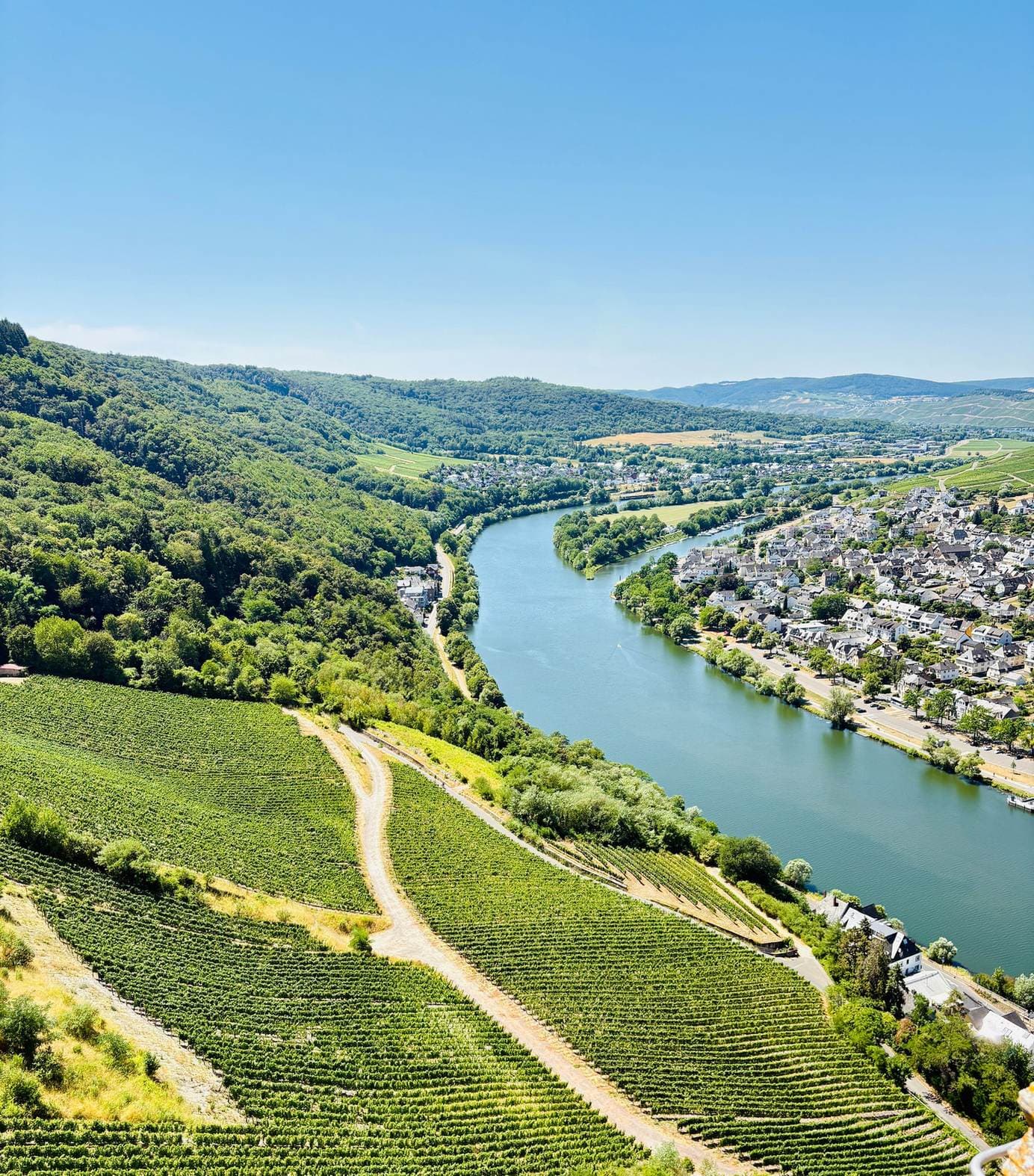
Riesling is regarded as a variety that reflects its origin especially clearly. There is no magic in this, rather a series of sober characteristics. The Wine Institute calls it a slow-ripening variety that makes „die höchsten Ansprüche an die Lage“ (our translation: “the highest demands on the site”), but only modest ones on the soil. A long ripening period means that slope, wind, water supply and night-time temperatures act on the grapes over many weeks. The DWI’s brochure for the English-speaking market stresses that Riesling develops many of its aromas only towards the end of ripening – precisely the phase in which sites differ most.
Then there is the cellar. The same brochure describes Riesling as a wine “innocent of oak”, free of wood-derived aromas. Where no oak takes centre stage, fruit and acidity remain in the foreground, and differences between slate, shell limestone (Muschelkalk) or porphyry are easier to taste – even if the precise cause of mineral impressions remains a matter for lively debate.
In the end, this fits the family tree. A wild vine for robustness, a Traminer for refinement and a peasant’s wine for vigour and acidity: from this unlikely family has come a variety that says less about itself than about the slope on which it grows.