The Nahe has an image problem that is really a compliment: it is hard to reduce to a single common denominator. The Mosel has its slate, Rheinhessen its limestone and loess, the Rheingau its broad south-facing slope. The Nahe has a little of everything, and sometimes all of it within a single vineyard. Taste Riesling here and what you are served is not a regional style but a short lesson in geology.
The region in figures
The Deutsches Weininstitut (German Wine Institute) gives a vineyard area of 4,166 hectares for 2025. Riesling is the most important variety with 1,225 hectares, closely followed by the Pinot family (the Burgunder varieties) with 1,107 hectares combined. The Nahe is thus one of Germany’s smaller wine regions, and Riesling accounts for just under 30 per cent of its vineyard area: the leading variety, but far from the only one. According to Wikipedia, the region is divided into a little over 300 Einzellagen, or single vineyard sites. To the north the Hunsrück shelters the valley, which the institute highlights as an advantage for viticulture.
Under another name
That the Nahe appears on labels today as a wine region in its own right is more recent than one might think. According to Wikipedia, it has only been listed as a wine region in its own right since 1971. An essay on the history of the Niederhausen state domain on regionalgeschichte.net describes the situation around 1900: Nahe wines, it says, lacked an identity of their own and were often sold under borrowed names such as “Rüdesheimer” or “Rheinwein” (Rhine wine). Proximity to the Rheingau evidently helped sales, but did little for the region’s own reputation.
Viticulture, by contrast, has a long history here. Wikipedia traces it back to Roman times, while the wine institute speaks of 2,000 years of winegrowing tradition. The ruined monastery of Disibodenberg, on whose slopes five very old vines of the rare Weißer Orleans variety were discovered in 2008, according to the Atlas der Weinkultur, is one of the places where this history is still visible today.
Prussia’s vineyard in the rock
A key chapter of more recent history plays out in Niederhausen. By a decree of 1 March 1901 the Prussian administration approved the purchase of land for a state model vineyard, from which the wine domain grew. From 1902, steep, rocky ground was cleared and terraced, partly by convicts, whose barracks remained in use until 1918. In the Kupfergrube site, a former mining area, the workers moved some 420,000 cubic metres of earth, according to the essay. The first vintage was picked in November 1907. In 1998 the domain was privatised. Today’s Gut Hermannsberg estate emerged from it and, according to Wikipedia, has traded under that name since 2010.
As early as 1899 the district president in Coblenz had ordered a classification of the vineyard sites in his administrative district, to which the Nahe then belonged. According to the essay, the sheet for the Nahe appeared in 1901, and the top sites it recorded lay right next to the future domain.
A geological mosaic
Why is the Nahe so varied? Because a great deal happened here a very long time ago: volcanism, marine deposits, desert periods. Wikipedia calls the Nahe the region with the greatest diversity of soils and the tightest changes between them in Germany; more than 180 soil variants were suspected and examined in a dedicated project. The wine institute is more restrained, naming slate, volcanic porphyry, and loess and loam soils. The Atlas der Weinkultur names quartzite, porphyry and slate soils, and at the Disibodenberg also sandstone, siltstone and clay slate.
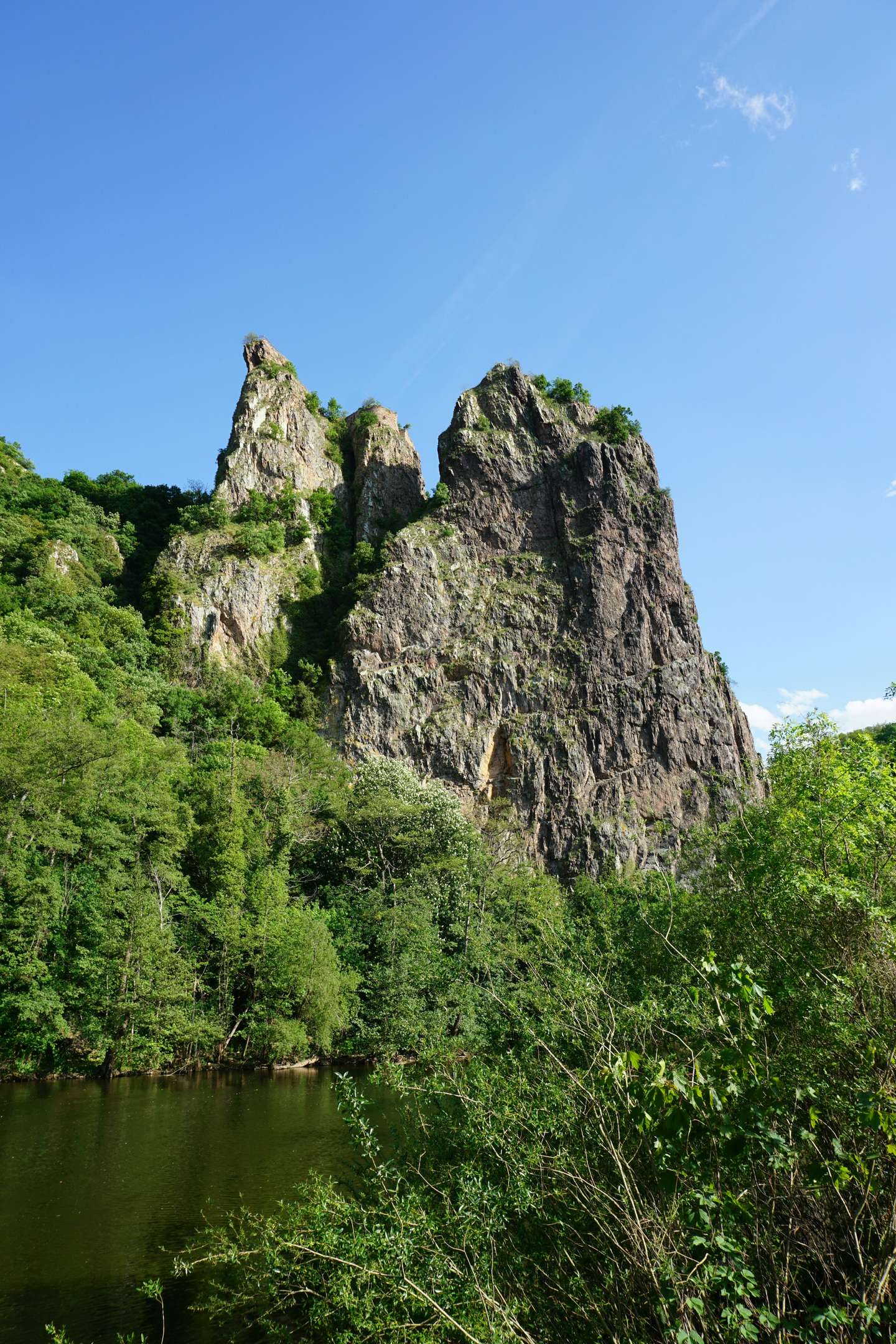
Broadly speaking: on the upper Nahe around Monzingen, slate dominates, some of it blue-grey, some red. In the middle section around Niederhausen, volcanic rocks such as porphyry come into play, often intermixed on a small scale with slate and other rocks. The most striking monument to this history is the Rotenfels near Bad Münster am Stein, a porphyry massif 202 metres high and, according to the Atlas der Weinkultur, the highest cliff face between the Alps and Scandinavia.
Hermannshöhle, Halenberg, Frühlingsplätzchen
Three sites show how differently Nahe Riesling can turn out. The Niederhäuser Hermannshöhle is a steep south-facing slope whose soil the Dönnhoff estate describes as a mixture of black-grey slate, volcanic igneous rock, porphyry and elements of limestone. According to the estate, it has been regarded as the Nahe’s most highly rated site for more than 100 years. It owes its name to a small gallery – a Höhle, or cave. Helmut Dönnhoff took over the family estate from his father Hermann in 1971, and since 2007 his son Cornelius has been in charge of the cellar. That the handover fell in the very year the region was established is a coincidence, but a pleasing one.
Further upstream in Monzingen lie Halenberg and Frühlingsplätzchen, the two best-known sites of the Emrich-Schönleber estate, which has been run by Frank Schönleber since 2018. The VDP (Verband Deutscher Prädikatsweingüter, Germany’s association of top estates) names blue slate and quartzite as the typical soil of the Halenberg. The importer VomBoden draws a finer distinction: in the Halenberg blue-grey slate predominates, producing wines of density and austerity, whereas the Frühlingsplätzchen has veins of red slate and comes across as more approachable and floral in its youth. Two slopes, one village, one estate – and yet two clearly distinguishable characters. That is the Nahe in miniature.
What you find in the glass
Because the bedrock changes so often, a Nahe style is hard to pin down. What many of its Rieslings share is a certain middle ground between the slender acidity of the Mosel and the fullness of the Pfalz. Rieslings from slate often come across as cool and taut, those from volcanic rock as spicy and dense, wines from loess sites as rounder and more approachable. On top of that comes the full range from dry to nobly sweet (edelsüß); from the Hermannshöhle, for instance, Dönnhoff bottles a Spätlese (“late harvest”) among other wines.
The best way to get to know the Nahe, then, is by comparison. Put two Rieslings from the same grower and neighbouring sites side by side, and the lesson in geology becomes a lesson in taste. Seen this way, the lack of uniformity is not a shortcoming but the real case for this small region.